In the early morning of January 3, hours before the sun would rise on Caracas, explosive flashes lit the city. Citizens bore witness to missiles raining down, hitting military bases across the area. It did not take long for videos of the destruction to surface online. Though a few hours passed until an official statement released, most had a guess as to what happened. Not long after the attacks, President Trump released a statement on Truth Social validating the theories of American involvement in the attack. Trump’s statement confirmed that the U.S. had carried out a strike against Venezuela that captured President Nicolas Maduro and his wife, Cilia Flores.
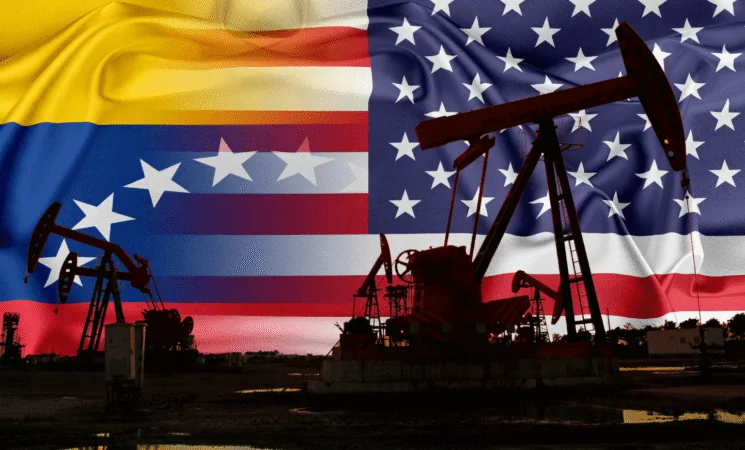
To many, the attack came as no surprise. Tensions between Trump and Maduro had risen in the months prior, and Trump’s designation of fentanyl as a weapon of mass destruction (WMD) made the attack seem imminent to many. It was not the first American attack on Venezuela, as Trump had already ordered strikes on numerous boats originating from Venezuelan shores. The president claimed that the boats held drug smugglers, though due to the nature of the strikes make those claims now difficult to substantiate. While it is not impossible to think that supposed drug smuggling was motivation enough for Trump’s invasion, looking to the past offers far more believable motivations for an American intervention in Venezuela. One potential reason for the invasion traces back to 2007 when former Venezuelan President Hugo Chavez kicked U.S. oil giants Exxon Mobil and ConocoPhillips out of the country. Since then, U.S. oil companies have found little success in setting up operations in the country, being caught in the crossfire of poor political relations. Now, with both a Trump-backed Venezuelan president and explicit plans to seize oil revealed by Trump, it seems like things will soon look up for these oil conglomerates.
Not only will these company executives profit from the invasion, but so will American politicians who will soon find themselves exorbitantly wealthy as well. A large number of U.S. senators hold huge shares in these oil companies. The estimated shares fall between $403,023 and $1,201,000, with as much as $1,106,000 of the shares being owned by republicans. Even many of the senators with no direct oil investments instead take lobbying money from PACs that exist to legally funnel oil money to politicians. Outside of the senate, other politicians make money the same way, most notably, President Donald Trump. With new Venezuelan drilling boosting the companies these politicians make money from, a very big payday may soon hit Washington.
Looking at the still developing situation, one can easily draw historical parallels, the most obvious of these stands in the 2003 American invasion of Iraq. In both invasions, the through line is similar. The U.S. makes questionable claims about WMDs and overthrows a foreign regime, creating billions for oil companies in the meantime. Even though Iraq stands as the freshest in public consciousness, it is not the first invasion of this kind, such as the Banana wars that occurred in the late 19th and early 20th centuries. In that string of conflicts, the U.S. continually intervened in Central America, overthrowing rulers who opposed the interests of American fruit companies, hence the name “Banana Wars.”
This trend of U.S. intervention carried on throughout the 1900’s, continuing in South America during the cold war. During that time, the CIA orchestrated numerous regime changes, removing often democratically elected left wing regimes and replacing them with right wing despots. Many of those regime changes have now caused much of the modern day instability in Latin America. That same instability now causes the poor economic development of said nations. Poor development which has led to an increase in crime, including drug trafficking, which finally brings things back to the modern day with Trump citing fentanyl as a large cause for the invasion of Venezuela.
Seeing those cycles in motion, it can prove difficult to have any optimism about the situation in Venezuela. Still, only by understanding history can society hope to not only understand the current moment but prevent wrongs from being repeated in the future.